
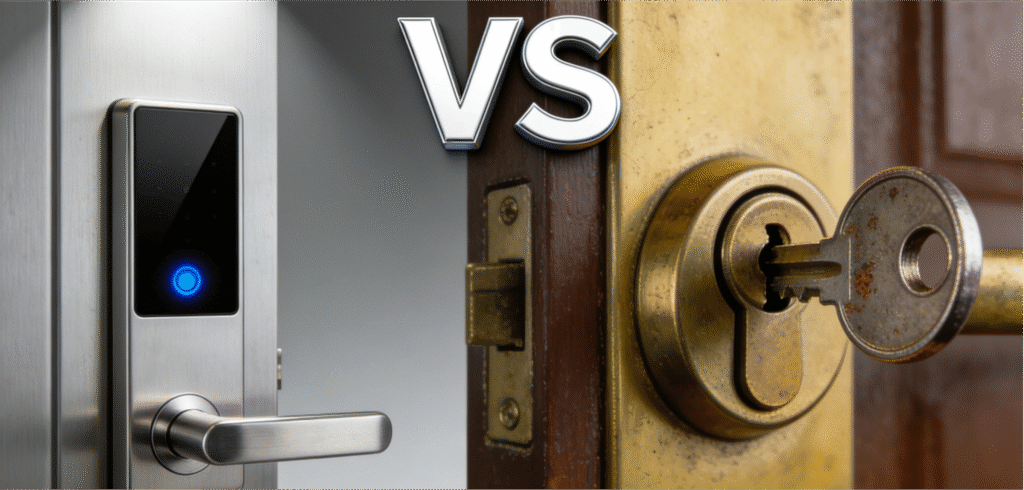
Traditional Deadbolt Lock
A deadbolt lock is a type of mechanical lock that secures doors with a solid, non-spring-loaded bolt that typically extends into the door frame. Unlike standard spring locks, such as latch bolts, deadbolts require manual activation via a key and thumb turn, making them highly resistant to forced entry. This makes them a popular choice for home and business security.
I. Key features
1. High security: resistant to kicking, prying, and lock-picking.
The hardened steel bolt physically blocks the door from opening unless retracted by a key or thumb turn. This makes them more secure than spring-loaded locks, which can be ‘shimmed’ open with a credit card.
2. Two main types:
Single cylinder: Keyed on the outside with a thumb turn on the inside (common for residential doors).
Double cylinder: Requires a key on both sides (used for doors with glass panels to prevent break-and-reach-in attacks).
3. No power is needed to operate it, making it fully mechanical and highly reliable during power outages. Unlike electronic or smart locks, which depend on electricity or batteries, deadbolts function consistently regardless of external power conditions. This mechanical simplicity also enhances durability and reduces the risk of malfunctions.
4. ANSI security grades
For maximum security, they must be aligned with the strike plate on the door frame. Security grades are rated according to standards such as ANSI/BHMA (e.g. Grade 1 = highest security for commercial use; Grade 3 = basic residential).
II. Advantages:
It can provide stronger protection against break-ins (e.g. forced entry by prying or kicking). Unlike spring bolts, it does not lock accidentally when the door closes. It is ideal for basic home security where convenience isn’t a priority. It is suitable for areas with frequent power outages as there are no electronics to fail.
Additionally, deadlocks offer superior resistance to forced entry, providing enhanced home security. Their straightforward design ensures long-term reliability and peace of mind, particularly in emergencies when electronic systems may malfunction. This makes deadlocks an essential component of any robust physical security system.
Smart Deadbolt Lock
A smart deadbolt lock is an advanced electronic lock that combines traditional mechanical security with modern technology. Typically featuring keyless entry via methods such as PIN codes, smartphone apps, fingerprint recognition or voice commands, it offers a convenient and secure alternative to traditional keys. Unlike standard deadbolts, smart deadbolts often include Wi-Fi or Bluetooth connectivity, enabling remote locking and unlocking, access logging and the provision of temporary guest codes. Many models also have a physical key backup for emergencies. Smart deadbolts offer the convenience and enhanced security of smart technology while maintaining the robust protection of a traditional deadbolt and seamless smart home integration. Some even include auto-locking and tamper alerts.
I. Key features
1. Multiple unlock methods
Unlike traditional deadbolt locks, which require a physical key, smart deadlocks offer several ways to unlock: Fingerprint scanner, PIN code keypad, smartphone app, voice control, NFC/RFID cards and physical key backup.
2. Remote access and monitoring:
It can check the lock status from anywhere, receive alerts for unauthorised access attempts and control the lock remotely. It can also receive alerts when the door is unlocked or tampered with.You can also check battery life and lock status in real-time via the app.
3. Auto-Lock & Scheduling
It can automatically lock after a set time and set temporary access codes for guests, cleaners or delivery personnel.
4. Enhanced Security
The product utilises encrypted signals, which prevent hacking and signal jamming. Moreover, it is equipped with a tamper alarm, which is an audible alert that is triggered if an attempt is made to gain entry forcibly. It is equivalent to ANSI Grade 1/2 standards, which are the same as those of high-security traditional deadbolts.
5. Battery-powered with backup options.
It retains a mechanical keyhole. It also has a manual thumb turn. These are the backup options. It runs on AA or lithium batteries. It can last 6–12 months. When the battery is low, it will alert you.
II. Advantages:
Unlike conventional locks, which rely solely on physical keys that can be lost, duplicated or stolen, smart deadbolts provide multiple keyless entry options, including fingerprint scanning, PIN codes, smartphone apps and voice commands. Remote management capabilities also allow you to lock or unlock your door from anywhere, receive real-time alerts, and monitor who enters or exits your home.
Another major benefit is the flexibility in managing guest access. Rather than making extra keys or worrying about unauthorised copies, smart deadbolts enable you to generate temporary or scheduled access codes for visitors, delivery personnel, Airbnb guests or service providers. These codes can be set to expire after a certain time or number of uses, enhancing security without compromising convenience. Even during power outages, smart deadbolts remain functional thanks to long-lasting batteries and emergency backup options, so you’ll never be locked out due to a power failure.
Furthermore, smart deadbolts can be integrated with smart home ecosystems and work with voice assistants and broader home security systems. This enables automated routines such as locking the door when you say ‘Goodnight’ or receiving alerts if the door is left unlocked. With advanced encryption, tamper alarms and high-security certifications, smart deadlocks deliver maximum protection while offering unparalleled convenience.
Which One Should You Choose?
Whether you choose a traditional or smart deadbolt depends on your security needs, lifestyle and budget. Below are some expert recommendations to help you decide:
1. Choose a traditional deadbolt if you prefer simplicity and don’t want to manage apps, Wi-Fi or batteries. It is also a good choice if you live in an area where power outages are common, as it is fully mechanical and works even during blackouts. When your budget is a concern. A deadbolt lock is more affordable upfront and requires minimal maintenance, and you don’t need remote access. Using a deadlock involves minimal tech hassle and no risk of hacking, software glitches or dead batteries.
In short, if you are a renter, budget-conscious buyer or someone who prioritises reliability over smart features, the deadbolt lock seems to be a good choice.
2. Choose a smart deadbolt lock if you want keyless convenience and remote access, which can help you check and control your lock from anywhere. If you frequently have to host guests, such as when you provide temporary codes for Airbnb, cleaners or delivery people, or if you are a smart home enthusiast who values smart home integration and security systems, then this is the service for you. If you are afraid of forgetting to lock the door, the auto-locking and alert features are useful. It locks itself and notifies you of suspicious activity.
All in all, if you are tech-savvy, a frequent traveller, a hotel host or someone who wants enhanced security and convenience, a smart deadbolt lock seems like a good choice.