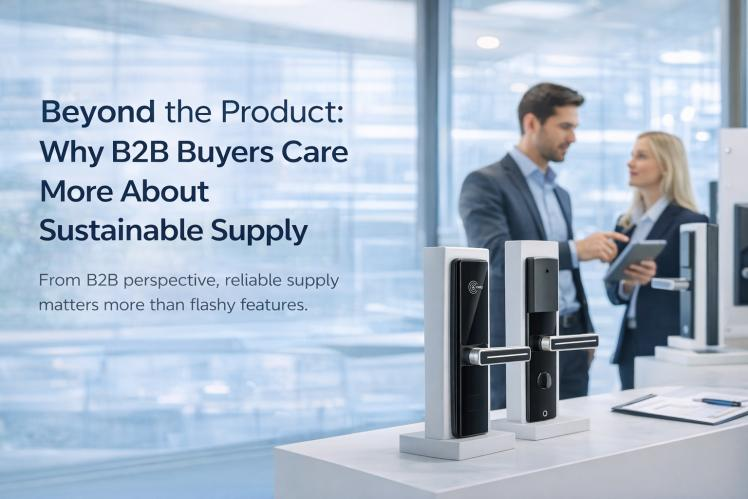

Why Sustainable Supply Matters in B2B Smart Lock Decisions
In consumer markets, smart locks are judged by features, design, and price. But for B2B projects—hotels, serviced apartments, office complexes, and commercial developments—the decision logic is fundamentally different. A smart lock in a commercial environment is rarely a one-time purchase. It becomes part of a larger infrastructure, deployed in phases, maintained for years, and sometimes replaced in batches. In this context, supply uncertainty translates directly into operational and financial risk. Project owners and system integrators are increasingly asking: Will this model be available next year? Can quality remain consistent across batches? What happens when supply chains fluctuate? For B2B buyers, sustainable supply is no longer a nice-to-have—it is a basic requirement for long-term project success.
What a Mature Smart Lock Supplier Must Offer
As smart locks become standard components in commercial projects, the supplier’s role evolves from product vendor to long-term solution partner. This shift demands capabilities that go far beyond hardware.
First, clear product lifecycle planning is essential. Frequent model changes or short product lifespans create serious risks for large-scale deployments. Mature suppliers maintain core models for extended periods and manage upgrades in controlled, transparent ways. This protects customers from costly re-certification, door structure redesign, or repeated market testing.
Second, consistent and scalable manufacturing matters more than ever. Across hundreds or thousands of units, reliability is far more valuable than any single impressive feature. Stable quality control systems, repeatable production processes, and predictable delivery schedules directly reduce project risk and operational uncertainty.
Third, project-level support becomes a critical offering. This includes model selection guidance, compatibility checks with existing door hardware, integration support with access control or property management systems, and clear deployment recommendations. In real-world projects, many challenges emerge after installation—not at the point of purchase.
Finally, long-term partnership reliability increasingly drives buying decisions. B2B customers are not seeking one-off transactions. They prefer suppliers who can support multi-year rollouts, phased deployments, and ongoing maintenance strategies—and who remain stable partners as their projects scale.
The Redefined Value Standard in B2B Smart Locks
The B2B market is quietly redefining what “value” means in the smart lock industry. The focus is shifting away from short-term feature comparisons and price-driven decisions toward stability, continuity, and deliverability. In this environment, the real competitive advantage is not just a well-designed product. It is the entire system built around that product: manufacturing capability, supply chain management, quality assurance, and long-term support infrastructure. Smart locks are no longer judged only by what they can do today, but by how reliably they can be delivered, maintained, and supported over time. For professional buyers, sustainable supply is not a marketing slogan—it is the foundation of long-term project success. The new currency in B2B smart lock procurement is not innovation speed, but predictability.
Conclusion
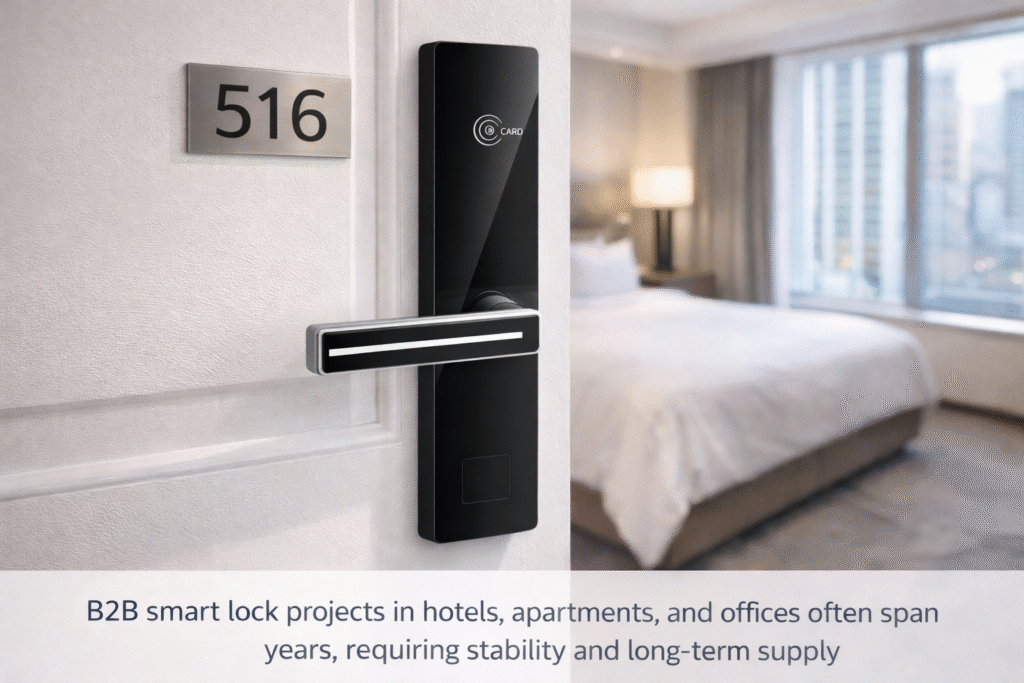
In the B2B smart lock market, the decision framework has fundamentally shifted. Buyers are no longer driven by features or price alone. Long-term supply stability, consistent quality across batches, and predictable product lifecycles have become essential decision factors. For commercial projects, smart locks are long-term infrastructure investments. Suppliers who can ensure sustainable supply, reliable delivery, and ongoing project support create genuine value and reduce operational risk. In this evolving landscape, the most competitive suppliers are not those with the most features—but those who offer the most predictability.